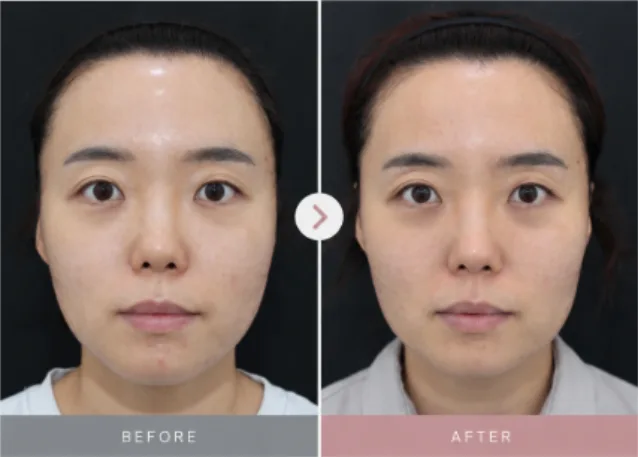
“My jawline looks a bit more defined, but why do my cheeks look more sunken?”
This change can be even more noticeable, especially for those who didn't have much facial fat to begin with. If you wanted a lifting procedure, but instead your face looks longer or the area under your front cheekbones appears sunken, “Could it be that my cheeks have sunken in?” because it causes worries to arise.
However, there is one thing we need to distinguish here.
Looking like you have hollow cheeks and actually having a reduction in cheek fat or tissue are not the same thing.
Not all changes in facial appearance after Ultherapy can be attributed to fat reduction, nor should actual noticeable changes be dismissed as mere optical illusions.
There is not just one reason why cheeks might appear sunken after Ultherapy.
Immediately after the procedure, your face may look a little different than usual.
Because Ultherapy is a procedure that delivers micro-focused ultrasound energy deep into the skin, temporary swelling, tenderness, and redness may occur after the procedure. Currently, the official Ultherapy user manual also states that mild swelling and tenderness may temporarily occur after face and neck procedures.
The problem is that as these initial changes subside, the contours of the face may appear more defined than before.
For example, if the swelling around the jawline subsides or the shadows across the entire face change, even if the actual volume has not decreased an optical illusion that makes the area below the cheekbones appear deepercan occur.
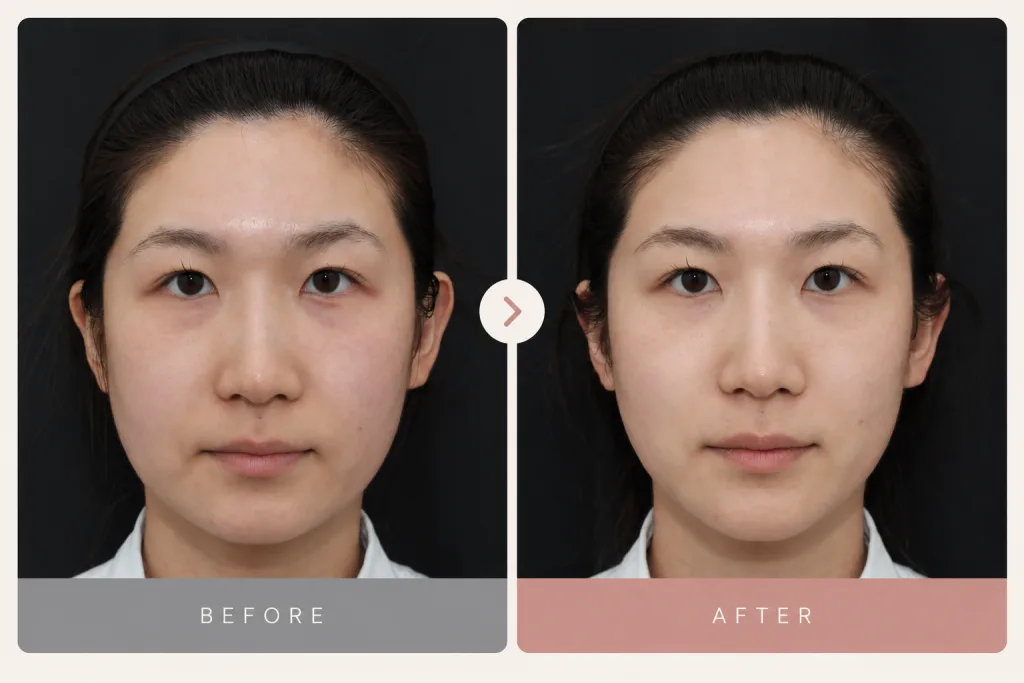
When taking before and after photos, changes that felt like “my cheeks look sunken” were actually sometimes just jawline definition and changes in shadows.
Therefore, it is not appropriate to look in the mirror right after the procedure and immediately judge whether volume has been lost.
Ultherapy is not originally a procedure to remove fat.
It is easy to understand if you look at the basic purpose of Ultherapy.
Ultherapy is a device that utilizes micro-focused ultrasound with visualization (MFU-V) to create thermal coagulation points at specific depths, inducing skin and tissue lifting and improving elasticity. Currently, the scope of its US FDA clearance focuses on skin lifting of the brow, neck, and submental areas, as well as the improvement of lines and wrinkles on the décolleté.
In other words It is not an approved device for fat-dissolving procedures to reduce facial fat.
However, one must not jump to the conclusion here that “hollow cheeks can never occur.”.
This is because in actual procedures, the anatomical structure of the face, fat distribution, skin thickness, and the area and depth of irradiation are all interrelated.
So, are there actually no cases of cheek hollows?
This part needs to be looked at a bit more closely.
The systematic review on MFU-V published in 2024 reviewed data from 19 studies and 506 patients. The reactions mainly reported in clinical literature were temporary edema, erythema, and post-procedure pain, with few significant adverse events. However, 1 case of subcutaneous atrophyThis has been reported. The researchers also separately reviewed 106 cases from the Manufacturer and User Facility Device Experience (MAUDE) database, noting that while events such as lipoatrophy and nerve-related symptoms were reported, a significant number of them had the limitation of being non-peer-reviewed and unverified cases.
This difference is important.
“Cases complaining of sunken cheeks have been reported.”is a fact and
“Ulthera generally reduces cheek fat.”The claim does not have the same meaning.
Based only on currently available evidence, Ultherapy cannot be considered a facial fat reduction procedure. However, we cannot unconditionally dismiss the experiences of individuals who actually noticed changes in facial volume after the procedure as mere optical illusions.
So in the end the process of evaluating by comparing an individual's pre- and post-procedure conditionThis is needed.
When it looks like sunken cheeks, we look at these differences.
In the clinic, we don't just listen to the words “my cheeks seem sunken” to determine whether fat loss has occurred.
Looking at the face from the front and sides, and comparing it with the pre-procedure photos, we check which areas have shown changes.
For example
Did the entire ball shrink uniformly?
Is it just a specific area that is sunken, like below the front cheekbones?
is it because the jawline has become more defined, making the cheeks appear relatively hollow
Did the original facial lines become visible as the swelling subsided after the procedure?
You need to distinguish.
Especially if one side of the face looks noticeably sunken, or if contour changes in a specific area continue to become more pronounced, it may be difficult to explain this by simple lighting or shadows alone.
People with less facial fat need to approach it more cautiously.
“I don't usually have much cheek fat. Would it still be okay for me to get Ultherapy?”
This kind of question is quite realistic.
When planning a lifting procedure for someone who originally lacks facial volume, simply How hard to pullRather than just looking Where should we improve and where should we preservemust be viewed together.
Especially for areas that create facial volume, such as the front of the cheeks or under the cheekbones, aggressive treatment is not always better.
You need to consider not only the amount of fat in the face, but also the skin thickness, degree of sagging, bone structure, and current contours together.
Therefore, even with Ultherapy, it is not appropriate to apply the same range and depth to everyone.
Should I also check how many Ultherapy shots I received?
Previously written Ultherapy 300 shots 600 shots As explained in the article, it is difficult to judge the results based on the number of shots alone.
Rather than whether it's 300 shots or 600 shots Which areas received shots and at what depthbecause it may have a more direct meaning.
The Ultherapy system can use different tips depending on the depth and is designed to allow treatment planning while viewing tissue in real-time imaging.
Therefore, it is also not accurate for someone with low facial volume to simply think that “getting fewer shots is safer.”.
how the treatment area, depth, and areas of the face to be preserved were set, along with the number of shotsmust be watched until.
If you are worried about cheek hollows after Ultherapy, how long should you wait?
You need to wait a little right after the procedure.
According to the official user manual, mild swelling after facial and neck treatments typically improves in about 3 to 72 hours, and tenderness in 2 days to 2 weeks. Even if temporary nerve-related symptoms occur, they are generally guided to recover within a few weeks.
Therefore, it is difficult to judge long-term cheek volume loss simply because the face appears more hollow or uneven than usual on the very day following the procedure.
However, rather than the changes decreasing over time, If the depression in a specific area continues to stand out or gets worseInstead of simply waiting, it is recommended to check with the medical institution where you received the procedure.
If you lost weight, it is unlikely to be because of Ultherapy.
When the face looks hollow after a procedure, it's easy to think only of Ultherapy, but facial volume is affected by various factors.
If you have recently lost weight, or if your diet and exercise habits have changed significantly, facial fat may decrease as well.
If another lifting procedure or fat reduction procedure was performed in combination, it simply becomes difficult to distinguish which treatment influenced the facial changes.
So during the consultation, the last few months received talking about other treatments and weight changes together.
If you are deciding between Ultherapy and Sofwave?
Previously written Sofwave vs Ultherapy This is also connected to the text.
Both procedures use ultrasound, but the way they deliver energy and their main targets are different.
Sofwave focuses on improving skin elasticity and fine wrinkles centering around the dermis, while Ultherapy Prime delivers ultrasound energy to multiple depths, making it possible to simultaneously assess sagging in the skin and deeper tissues.
Therefore, A face lacking volume is not an issue where you should unconditionally decide by ruling out either Sofwave or Ultherapy.
First, it is important to distinguish whether the biggest issue on your face right now is skin elasticity, tissue sagging, or a lack of volume itself.
→ Sofwave vs. Ultherapy, both are lifting treatments, but which one is right for my face?
“I'm worried about cheek volume loss, can I still get Ultherapy?”
For this question, it is most accurate to judge by seeing the face in person.
This is because the direction of treatment may vary depending on whether you originally have low facial volume, your cheeks are already hollowed out, or how much sagging you have.
During counseling, simply
“Will I get cheek hollows?”
Rather than asking,
“Which areas of my face need lifting and which areas should preserve volume?”
You can get a more specific answer by asking that way.
It is also a good idea to take a "before" photo of your face. Taking it under the same lighting and from the same angle helps determine whether the changes after the procedure are real or just differences caused by swelling or shadows.

If your cheeks look sunken after Ultherapy, check this way
If you looked in the mirror after the procedure and felt that one cheek looked a little sunken, you don't need to jump to conclusions right away.
First Compare with the pre-procedure photo taken at the same angle and lightingGive it a try.
Next, check whether the change appears overall or is limited to a specific area.
If early reactions such as swelling or tenderness are present, the recovery process should also be considered.
Conversely, if the depression in a specific area continues to worsen over time or changes noticeably on only one side, it is recommended to have it evaluated by a medical professional.
This is because it is difficult to determine actual fat reduction based solely on photos or online reviews.
Ultimately, how should we view Ulthera cheek volume loss?
Ultherapy is basically not a procedure to remove facial fat. Its official indications are also focused on lifting and wrinkle improvement.
In clinical literature, most adverse events were temporary edema, erythema, pain, etc., and cases reporting subcutaneous atrophy were very limited. On the other hand, post-marketing data included reports of complaints such as lipoatrophy, but many of these have the limitation of being unverified cases for which it is difficult to confirm a causal relationship.
So “Rather than making absolute statements in a single sentence, such as ”Ultherapy never causes sunken cheeks“ or ”Ultherapy melts fat,", it is right to see what actual changes appeared on the face after the procedure.
Especially for those who naturally have little facial volume or already have sunken cheeks, An approach that designs areas needing volume preservation and areas needing lifting together, rather than pulling the entire face equally.This is needed.
In the end, what matters with Ulthera is not how strongly or how much is done, deciding first what to change and what to keep on my face.
The suitability and treatment range of Ultherapy Prime may vary depending on the skin thickness, fat volume, degree of sagging, and anatomical structure of the face. If unexpected contour changes persist or worsen after the procedure, please visit the medical institution where you received the treatment for a consultation.